
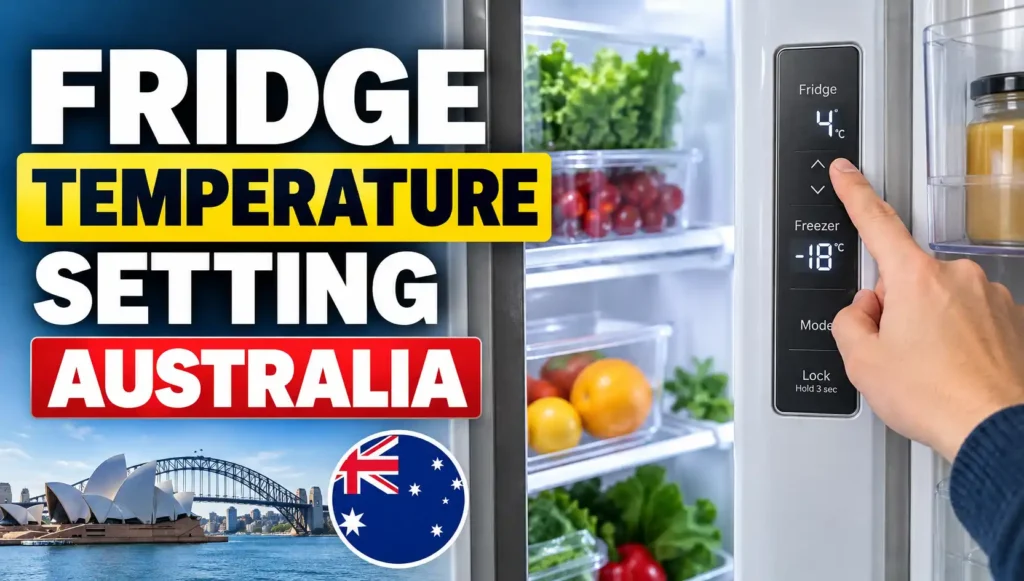
Food Standards Australia New Zealand (FSANZ) requires potentially hazardous food to be kept at 5°C or colder, with the freezer at -18°C or below. In practice, most fridges are set a little colder than the bare legal threshold — commonly between 3°C and 4°C — to leave a buffer for temperature swings when the door opens or fresh groceries go in still warm from the car. This guide covers what the correct fridge temperature setting actually is in Australia, why the target sits below the legal minimum rather than right on it, how to check your refrigerator is actually reaching it, and what to do if it isn’t.
How Cold Should a Fridge Be? The Short Answer
- Fridge (fresh food compartment): 3°C to 4°C as a practical target, and no warmer than 5°C under FSANZ’s food safety standard
- Freezer: -18°C or colder
That’s the number that matters for food safety. The rest of this guide covers the reasoning behind it, and the details that actually affect whether your fridge is hitting it.
Why 5°C Is the Legal Line, Not the Target
FSANZ defines 5°C to 60°C as the “temperature danger zone” — the range in which bacteria that cause food poisoning multiply fastest. Under the Food Standards Code, potentially hazardous food must be kept at 5°C or colder, or 60°C or hotter, essentially everywhere in between those two states. Below 5°C, bacterial growth slows significantly; it doesn’t stop, but it’s slow enough to keep food safe for a normal storage period.
That’s a legal and food-safety threshold, not a recommended setting. Fridges don’t hold a single temperature — they cycle within a range as the compressor turns on and off, and they run warmer near the door and cooler near the back and bottom. A refrigerator set to exactly 5°C on the dial can easily drift a degree or two above that during a normal cooling cycle or when the door’s been open a few times loading groceries. Setting the target a couple of degrees colder, generally 3°C to 4°C, builds in room for that normal fluctuation without ever letting the coldest and warmest points in the compartment cross into the danger zone.
Best Fridge Temperature: Why Not Just Set It Even Colder?
Colder isn’t automatically safer once you’re below 5°C, and it comes with real costs. A fridge running significantly colder than necessary uses more energy for no food safety benefit, and it increases the risk of certain foods freezing when they shouldn’t — most vegetables, some dairy, and anything in a crisper drawer positioned near a cold air vent can freeze and lose texture at temperatures well above what would actually damage frozen meat or bread. If food in your fridge is regularly freezing, particularly at the back or in the crisper, the fridge is very likely running colder than the 3°C to 4°C range that’s actually recommended.
Freezer Temperature
FSANZ’s standard for frozen food storage is -18°C or below. This isn’t just a safety line the way 5°C is for the fridge — it’s also the temperature that actually keeps frozen food in good condition long-term. Above -18°C, ice crystals within food gradually grow larger over time, which affects texture and can accelerate freezer burn, even if the food is still technically frozen and hasn’t entered the danger zone.
Checking Your Fridge Thermostat Setting Is Accurate
The dial or digital display on most fridges is a target temperature control setting, not a live, verified reading of the actual air temperature inside the compartment — and it’s rarely from the same probe or location that best represents where your food sits.
The reliable way to check is with an independent fridge thermometer. Place it in the middle of a centre shelf, away from the door and away from any vent, and leave it for several hours or overnight before reading it — fridge temperature takes time to stabilise after the door’s been opened or the thermometer’s just been placed. If the reading sits comfortably at 3°C to 4°C, the fridge is doing its job. If it’s regularly reading above 5°C, that’s worth acting on rather than just nudging the dial, since a fridge that can’t hold temperature at a normal setting usually has an underlying fault rather than simply needing a colder number.
Why the Fridge Temperature Range Isn’t Even Throughout the Compartment
A fridge has temperature zones, and it’s worth knowing them when deciding where to store what:
- The door shelves run warmest, since they’re most exposed to room air every time the door opens. This is the right place for condiments and drinks, not the most perishable items like milk or raw meat, despite many fridges having a dedicated door shelf that looks designed for exactly that.
- The back and bottom of the main compartment run coldest, closest to where cold air enters from the evaporator.
- The crisper drawer runs a little colder than the shelves above it, since cold air is denser and settles downward — useful for produce, but also where over-freezing shows up first if the fridge is running too cold overall.
Storing raw meat, poultry and seafood in the coldest part of the fridge — generally the bottom shelf, in a container that stops any drips reaching food below — reduces both spoilage risk and cross-contamination risk, regardless of what the display on the door says the fridge is set to.
What Affects Refrigerator Temperature Control Beyond the Dial
A fridge set correctly can still fail to hold that temperature for reasons that have nothing to do with the dial:
- An overloaded fridge restricts airflow. Cold air needs to circulate between items to cool them evenly; a fridge packed solid can run warmer at the front and centre even though the thermostat thinks it’s at target, since the sensor isn’t necessarily reading the warmest spot.
- A door that isn’t sealing properly lets warm air in continuously, which the compressor then has to work constantly to counteract — sometimes successfully, sometimes not, depending on how bad the seal is.
- A dirty or blocked condenser reduces the fridge’s ability to reject heat, meaning it has to run longer to hit the same target temperature, and in worse cases can’t reach it at all.
- Frequent or prolonged door opening, common in larger households or during entertaining, introduces warm air faster than the fridge can recover, particularly if it’s already running close to its limit.
If your refrigerator is set correctly but a thermometer shows it’s not actually holding a safe fridge temperature range of 3°C to 5°C consistently, one of these is generally the reason — and it’s a fault worth diagnosing rather than compensating for by setting the dial colder. Call 0468 340 685 if you’d rather have it checked properly than keep guessing.
Safe Refrigerator Temperature During a Power Outage
FSANZ’s general guidance is the 2-hour/4-hour rule: potentially hazardous food that’s spent less than two hours total in the temperature danger zone (above 5°C) is still safe to use or refrigerate again; between two and four hours it should be used immediately rather than stored again; beyond four hours it should be discarded. This applies whether the time above 5°C comes from a power outage, a fridge fault, or food simply being left out.
Keeping the fridge and freezer doors closed during an outage significantly slows how fast the internal temperature rises — a full freezer can often hold a safe temperature for a day or more if left unopened, while a fridge has considerably less buffer, typically several hours.
Refrigerator Temperature Guide for Commercial Kitchens and Food Businesses
The same 5°C threshold applies to commercial refrigeration under FSANZ Standard 3.2.2, but the compliance obligations go further than a domestic kitchen. Food businesses generally need to be able to demonstrate temperature control is actually happening, not just assumed — through calibrated thermometers, temperature logs at receiving and storage, and documented checks rather than a dial setting alone. Under the standard, potentially hazardous food received, displayed, transported or stored outside 5°C or colder (or 60°C or hotter) needs a documented safe alternative system to justify it, or it’s considered non-compliant.
For cool rooms and commercial refrigeration specifically, this generally means a fixed or logged temperature record, an alarm for temperature excursions, and a defined response process if a unit drifts out of range — considerations well beyond what applies to a household fridge but built on the exact same underlying science.
Frequently Asked Questions
What is the correct fridge temperature setting in Australia?
FSANZ requires potentially hazardous food to be kept at 5°C or colder. In practice, most fridges are set a little colder than that legal minimum, typically 3°C to 4°C, to allow for normal temperature fluctuation from door opening and the compressor cycle without ever crossing into the danger zone.
What temperature should my freezer be set to?
-18°C or colder, per FSANZ’s standard for frozen food storage. This is both a food safety threshold and the temperature that best preserves food quality and texture over time.
Is my fridge’s digital display an accurate reading of the internal temperature?
It’s a reasonable guide but not a substitute for an independent thermometer, since the display reflects a setting and a sensor reading from one location, not necessarily the warmest or most representative point in the compartment. Checking with a separate fridge thermometer placed on a centre shelf gives a more reliable picture.
Why does food freeze in my fridge if it’s not set below zero?
The coldest points in a fridge, typically the back wall and lower shelves, can drop below zero even when the average compartment temperature reads correctly, particularly if the fridge is running colder than the recommended 3°C to 4°C range or if airflow is uneven. A fridge that’s genuinely too cold overall, or a specific fault like a stuck damper, can also cause this.
How long can food stay safe if my fridge stops working?
FSANZ’s 2-hour/4-hour rule applies: less than two hours above 5°C and food is still safe, two to four hours means it should be used immediately rather than stored again, and beyond four hours it should be discarded. Keeping the door closed during a fault or outage significantly extends how long the compartment stays cold enough.
Do commercial fridges need to meet a different temperature standard than home fridges?
The core temperature threshold is the same 5°C under FSANZ Standard 3.2.2, but commercial operators have additional obligations to demonstrate compliance — calibrated thermometers, temperature logs, and a documented response if a unit drifts out of range, rather than simply setting a dial and assuming it’s correct.
My fridge is set correctly but a thermometer shows it’s running warm. What’s wrong?
A correctly set fridge that isn’t reaching temperature usually points to a fault rather than the setting itself — commonly a door seal that isn’t sealing, a blocked or dirty condenser restricting heat rejection, or the fridge being overloaded in a way that blocks airflow. It’s worth a proper diagnosis rather than continuing to lower the dial, since that just makes the fridge work harder without fixing the actual cause.
Get Your Fridge Temperature Checked Properly
If you’re not confident your fridge is actually holding a safe temperature, or a thermometer check has shown it’s running warmer than it should, Fridge Repair Experts can diagnose the cause and repair it on the spot in most cases — for households and food businesses. Licensed technicians, genuine spare parts, and a workmanship warranty on any repair carried out.
Call 0468 340 685 to book a mobile, on-site diagnosis.