
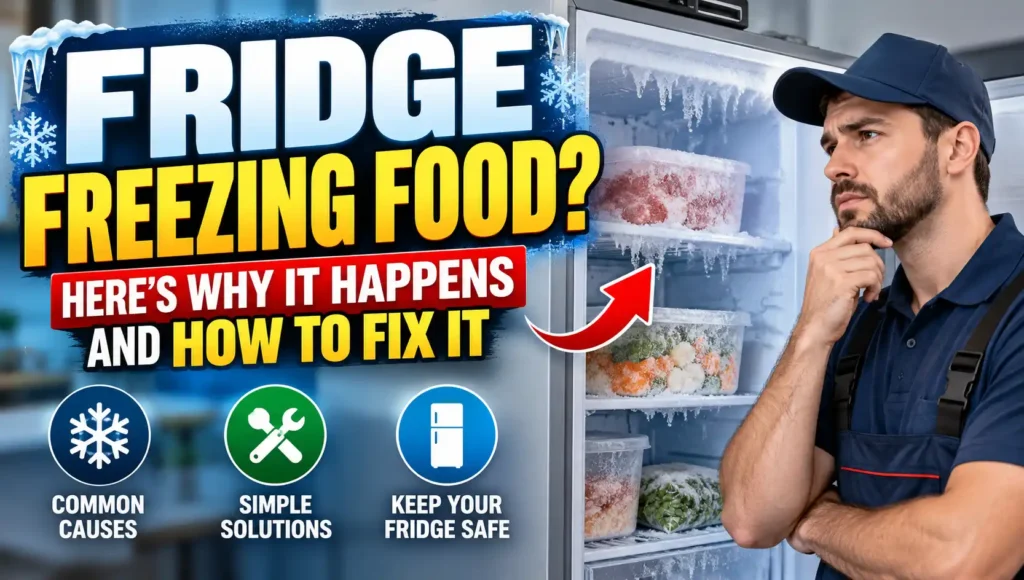
A fridge freezes food when the fresh-food compartment drops below roughly zero degrees, usually because the thermostat or temperature sensor is telling the system to run too cold, or because cold air is escaping into the compartment instead of being properly regulated. Neither cause is usually serious, and most are straightforward to diagnose once you know what to check.
This guide covers why it happens, the specific patterns worth noting — food freezing at the back, on the bottom shelf, or just certain items like vegetables and drinks — what you can safely check yourself, and when the fault needs a licensed technician.
Why Is My Fridge Freezing Food?
A fridge manages its internal temperature with a mix of mechanical and electronic components: a thermostat or temperature sensor reading the compartment, a damper or vent system controlling how much cold air moves in from the evaporator, and on newer appliances, a control board coordinating all of it. When any one of those parts fails or drifts out of calibration, the compartment can end up running at freezer temperatures without anyone having touched the dial.
Common Causes
Thermostat Set Too Cold, or a Faulty Thermostat
The simplest explanation, and the one worth ruling out first, is that the dial has been bumped colder than intended — easily done while loading groceries, or by someone else in the house adjusting it without mentioning it.
If the setting checks out and food is still freezing, a failing thermostat is the next likely candidate. Thermostats often fail gradually, running progressively colder over weeks rather than dropping out all at once, which is why the problem can feel sudden even though it’s been building for a while.
Temperature Sensor or Thermistor Fault
Most modern fridges use a temperature sensor — sometimes called a thermistor — rather than a simple mechanical thermostat. It measures the actual compartment temperature and reports it to the control board, which decides how long to run the compressor and how far to open the damper.
If that sensor reports a warmer reading than what’s actually in the compartment, the system keeps cooling well past the point it should stop. The fridge gets colder and colder because, as far as the sensor is concerned, it’s still too warm.
Blocked or Restricted Air Vents
Cold air reaches the fridge compartment from the evaporator through one or more vents, usually along the back wall. If a vent gets blocked — by food packed too close to it, or by ice building up around it — the airflow pattern changes and can concentrate cold air in one spot rather than spreading it evenly.
This is one of the most common causes of food freezing specifically at the back of the fridge, covered in more detail below. It’s also one of the easiest things to check and fix without any tools, and it’s often the explanation when the whole fridge seems to be running unusually cold rather than just one shelf.
Damper Stuck or Faulty
Many fridges use a damper — a small motorised or wax-motor flap — to control how much cold air passes from the freezer or evaporator side into the fresh-food compartment. If it sticks open, cold air flows through continuously instead of in controlled bursts, and the compartment runs far colder than it should.
Suspect a damper fault when the fridge seems to run normally for a while and then drops noticeably colder, particularly if the freezer itself is working fine.
Defrost System Faults
The defrost system periodically melts the thin layer of frost that naturally builds on the evaporator coil. A fault here — commonly the defrost thermostat or timer — lets ice build up excessively, which changes airflow and can push more cold air into the fridge compartment than intended.
This tends to develop gradually and often comes with other signs: unusual frost patterns on the back panel, or a fridge that seems to cycle between running very cold and briefly warming up.
Control Board Fault
On fridges with digital displays and electronic temperature control, the control board coordinates the sensor reading, the compressor, the damper and the defrost system together. A fault here can make any of those components behave incorrectly even though each one is individually fine — which is what makes control board faults some of the harder ones to pin down without proper test equipment. It’s also a common explanation for a fault that seems to come back after an apparent fix, since the underlying electronics are still misreporting even if something else was temporarily adjusted.
Food Placement Near a Vent
Not every case is a fault at all. Food stored directly against a vent — in the back corner of a shelf, or in a drawer positioned near where cold air enters — can freeze simply from proximity to the coldest point in the fridge, even when the appliance is working exactly as designed. Rearranging food away from vents for a few days is a free, five-minute test worth doing before assuming anything is broken.
Food Freezing at the Back of the Fridge
This is one of the most specific patterns people describe, and it points fairly reliably to the vent system. The back wall is where cold air enters, so it’s naturally the coldest point in the compartment — a mild gradient from back to front is normal. The problem starts when that gradient gets extreme: food freezing solid at the back while the front of the same shelf sits well above zero usually means a blocked vent, food packed too close to it, or a damper letting through more cold air than it should.
Food Freezing on the Bottom Shelf or in the Crisper
Cold air is denser than warm air and settles toward the bottom of the compartment, so the lower shelves and crisper drawer naturally run a little colder than the top — even in a fridge working correctly. When that gradient becomes extreme enough to freeze produce, the usual causes are a thermostat or sensor fault pulling the whole compartment colder, or a crisper humidity setting inadvertently trapping cold air against the contents. The humidity control is often the overlooked one — a setting meant to preserve moisture can, on some models, also concentrate cold air around the drawer.
Vegetables and Drinks Freezing First
Vegetables and drinks are usually the first things people notice, simply because the sign is obvious — a frozen lettuce leaf or a slushy bottle is hard to miss, whereas a slightly-too-cold cut of meat might go unnoticed for longer.
Vegetables freeze fastest because of their high water content, and because they’re often stored in the crisper or on the lower shelves, which run coldest to begin with. Bottles and cans kept upright near the back wall or in door shelves close to a vent are similarly prone to it. If drinks are freezing before anything else, treat it as an early warning sign worth acting on rather than waiting for more of the fridge to be affected.
What You Can Safely Check Yourself
A few checks are free and safe to try before booking anyone:
- Confirm the thermostat setting hasn’t been bumped colder than usual.
- Move food away from vents, particularly anything sitting directly against the back wall.
- Look for visible ice build-up around a vent or on the back panel.
- Try a different crisper humidity setting, if your fridge has one, for a few days.
- Give any change 24 to 48 hours before judging the result — fridge temperatures take time to settle.
What’s not worth attempting yourself: opening the sealed refrigerant system, replacing a control board, or working on internal wiring. These require a refrigeration licence and carry real risk of injury or further damage if attempted without the right training and equipment.
When to Call a Professional
If the thermostat setting checks out, food is well clear of the vents, and the problem is still there after a couple of days, it’s time for a proper diagnosis. Call sooner rather than later if:
- Food is freezing solid, not just running a bit cold
- The problem has clearly worsened over a short period
- You notice unusual frost patterns on the back panel
- Only the fridge section is affected while the freezer runs normally, or the other way around
- The fault comes and goes in a repeating pattern
A licensed technician can properly test the thermostat, sensor, damper and control board rather than guessing — checking actual compartment temperature against what the sensor reports, inspecting the damper’s operation, and where relevant, checking evaporator fan speed and airflow through the vents. None of that is reliably diagnosable by ear or by eye.
Fridge Repair Experts provides mobile, on-site diagnosis for a fridge freezing food, with licensed technicians attending your address and genuine spare parts carried on board for common faults like a failed damper, thermostat or sensor. Call 0468 340 685 to book a diagnosis.
Freezing vs Not Cooling Enough
Worth being clear on the difference, since the two get confused despite being close to opposites. A fridge not cooling enough runs too warm — food spoils faster than it should, and in the worst case the compressor has stopped altogether. A fridge freezing food runs too cold, generally from a fault somewhere in the temperature regulation chain rather than the cooling system failing outright.
Both faults can involve the same components — thermostat, sensor, control board, compressor — which is exactly why a proper diagnosis beats guessing from the symptom alone. An appliance that used to run warm and now runs cold, or the reverse, can be the same part failing differently as it continues to degrade.
Frequently Asked Questions
Why is my fridge suddenly freezing food when it never did before?
A sudden change usually points to a component failure rather than a gradual drift — a stuck damper, a failing thermostat, or a sensor reporting incorrectly are the most common causes. It’s worth booking a diagnosis promptly, since the fault is unlikely to resolve on its own.
Is it normal for the back of my fridge to be colder than the front?
Yes, to a degree. The back wall is typically where cold air enters, so a mild gradient from back to front is expected. It only becomes a problem when that gradient is extreme enough to actually freeze food at the back while the front sits at a normal temperature.
Can I fix this myself?
Some causes can be checked and corrected without any technical skill — the thermostat setting, food placement, and crisper humidity are all safe to try. Faults in the thermostat, sensor, damper or control board need professional diagnosis and repair, since they involve internal electrical components and, in some cases, licensed refrigerant handling.
Why is my fridge freezing food but the freezer seems fine?
That pattern usually points to a fault specific to the fresh-food side’s temperature regulation — the thermostat, sensor, or the damper controlling airflow into that section — rather than a fault affecting the whole system, since the freezer draws on a different part of the same setup and is clearly still working.
How long should I wait before calling a technician?
If a simple check like adjusting the thermostat or rearranging food doesn’t help within 24 to 48 hours, it’s reasonable to book a diagnosis. If food is freezing solid, getting rapidly worse, or the pattern is unusual, there’s no need to wait that long.
Does this waste more electricity?
Generally yes. A fridge running colder than necessary works harder than it needs to, which means higher energy use for no benefit and added wear on the compressor and other components over time. Fixing the underlying fault typically restores normal running as well as protecting what’s stored inside.
Book a Diagnosis
If your fridge is freezing food and the checks above haven’t resolved it, Fridge Repair Experts can diagnose the actual cause and repair it on the spot in most cases. Licensed technicians, genuine spare parts, and a workmanship warranty on any repair carried out.
Call 0468 340 685 to book a mobile, on-site diagnosis.