
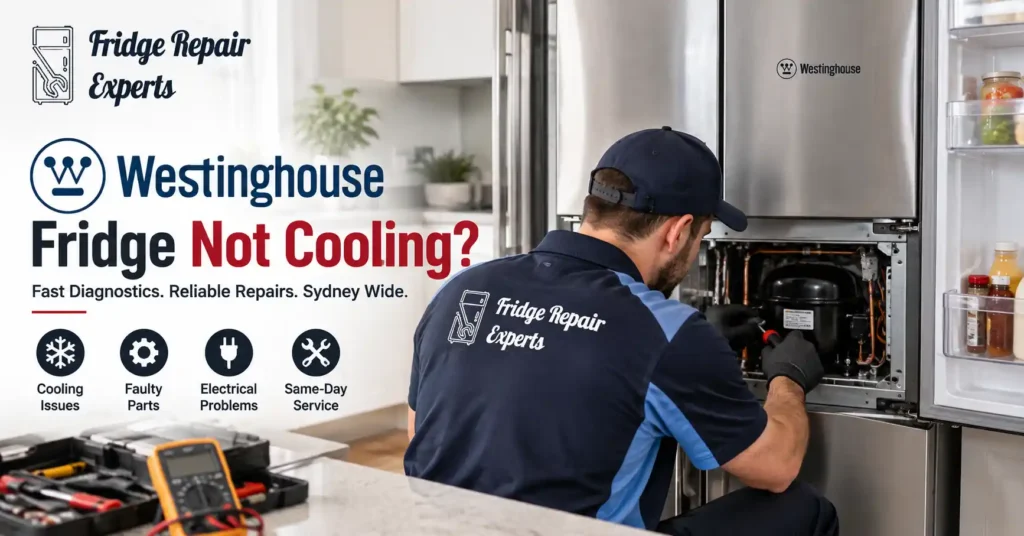
A Westinghouse Fridge not cooling, or a Westinghouse fridge stopped cooling suddenly, almost always comes down to one of a handful of causes: a door seal letting warm air in, a fouled condenser struggling to release heat, a failed evaporator fan not circulating cold air, or — less commonly but more seriously — a fault in the compressor or a refrigerant leak. Which one you’re dealing with usually shows itself through a specific pattern, covered below, and most causes are worth checking in a particular order before assuming the worst.
A Quick Note on Westinghouse Specifically
A Westinghouse fridge cooling problem is common enough that it’s worth knowing how Westinghouse’s own support structure works before troubleshooting. Fridges sold in Australia are built on shared Electrolux platforms, and Westinghouse doesn’t publish a detailed public fault-code or troubleshooting list the way some other brands do — their own support guidance generally points customers to their model’s manual or to Electrolux Customer Care for anything beyond the basics. That means this guide focuses on diagnosing the fault by its symptoms and pattern, which works reliably across the range, rather than by a specific error code, since Westinghouse fridges mostly don’t display one for this kind of fault.
Start Here: Is the Freezer Also Warm?
This is the single most useful thing to check first, because it splits the likely causes into two very different groups.
If the freezer is cold but the fridge section is warm, the fault is most likely airflow or a control component specific to the fridge side — a blocked air vent, a failing damper, or a thermostat or sensor issue — rather than the compressor or sealed system. This is generally the less expensive and quicker fault to fix.
A Westinghouse fridge warm but freezer cold points one way, as covered above. If both the fridge and the freezer are warm, or the compressor doesn’t seem to be running at all, the cause is more likely upstream — the compressor itself, the condenser, or a refrigerant leak affecting the whole system rather than just one compartment.
Common Causes
A Westinghouse fridge not getting cold at all, rather than just running a little warm, usually narrows things down to one of the causes below.
Door Seal Not Sealing Properly
A perished, torn, or misshapen door seal lets warm, humid air into the fridge continuously, and the compressor ends up running far more than it should trying to keep up — sometimes successfully for a while, sometimes not. This is the easiest cause to check yourself: run your hand around the seal feeling for gaps, or close the door on a piece of paper and see if it slides out easily anywhere along the seal. If it does, the seal isn’t doing its job — a straightforward fix and one of the more common causes of a Westinghouse fridge not cooling properly.
Dirty or Blocked Condenser Coils
The condenser is where the fridge releases the heat it’s pulled out of the food compartments, and it needs airflow to do that efficiently. Dust, pet hair and general household grime build up on the coils over time — usually located at the back or underneath the fridge — and a fouled condenser forces the compressor to work much harder for the same result, eventually struggling to keep up at all. This is worth checking and cleaning periodically regardless of whether you’re having a problem, since it’s one of the more preventable causes on this list.
Failed Evaporator Fan
The evaporator fan circulates cold air from the evaporator coil through the fridge and freezer compartments. If it fails, the compressor can be running perfectly well and still not actually cool the compartments, because the cold air it’s generating isn’t being distributed. A failed evaporator fan often comes with a noise warning beforehand — a grinding, rattling or squealing sound — before it stops working altogether.
Thermostat or Temperature Sensor Fault
A Westinghouse fridge temperature problem often traces back here. The thermostat, or on newer electronic models a temperature sensor, is what tells the system how much cooling to deliver. If it fails or reports incorrectly, the fridge can run its cooling cycle far less than it should, leaving the compartment warm even though the compressor and fans are otherwise fine. This is a common cause of a Westinghouse fridge cooling issue where everything sounds normal but the compartment just never quite gets cold enough.
Defrost System Fault
If the automatic defrost system fails — commonly the defrost heater or defrost thermostat — ice can build up excessively on the evaporator coil. That ice restricts airflow the same way a blocked vent would, and cooling gradually gets worse as the ice builds rather than failing all at once. This often shows up alongside visible frost build-up if you can see the evaporator area, or a fridge that cooled fine a few weeks ago and has been getting steadily worse since.
Refrigerant Leak
If the sealed refrigerant system has developed a leak, the fridge will gradually lose its ability to cool as refrigerant is lost, sometimes alongside a hissing sound at the point of the leak or a compressor that runs constantly without ever quite reaching temperature. This isn’t something to attempt to diagnose or fix yourself — locating and repairing a refrigerant leak requires a refrigeration licence, and simply adding more refrigerant without finding the leak just means the same fault returns.
Compressor Fault
The compressor is the heart of the cooling system, and a failing one is the more serious end of this list. Signs include a compressor that hums but doesn’t start, clicks repeatedly without running, or runs constantly without the fridge ever cooling properly. Some of these symptoms — particularly repeated clicking — can actually be a failed start relay or overload protector rather than the compressor itself, which is a much cheaper fix, so it’s worth having this properly tested rather than assuming the worst.
What You Can Safely Check Yourself
A few things are worth checking before booking a technician:
- The door seal, using the paper test described above.
- The condenser coils, for visible dust or pet hair build-up, and whether there’s enough clearance around the back and sides of the fridge for air to circulate.
- How full the fridge is. An overloaded fridge restricts internal airflow, which can mimic a genuine fault even when every component is working fine.
- Whether the thermostat dial has been bumped. Simple, but worth ruling out before anything else.
- Unusual noise, and where it seems to be coming from — this narrows down a fan or compressor issue considerably before a technician even arrives.
What’s not worth attempting: opening the sealed refrigerant system, testing or replacing the compressor, or working on internal electrical components. These need a licensed refrigeration technician, both for safety and because they’re not legal to handle without the right qualification.
When to Call a Technician
Book a proper diagnosis if:
- The door seal and condenser check out fine and the fridge is still not cooling
- Only one compartment is affected and adjusting the thermostat makes no difference
- You hear a hiss, or the compressor runs constantly without the fridge reaching temperature
- The compressor hums, clicks repeatedly, or doesn’t start at all
- The problem has been getting steadily worse over days or weeks rather than appearing suddenly
A Westinghouse fridge technician, or the right refrigerator repair Sydney households already use, can test the thermostat, sensors, fans and compressor properly, and confirm whether a fault is a simple component swap or something more involved, rather than you guessing and potentially replacing a part that wasn’t actually the problem — the same applies whether you call it Westinghouse fridge repair or Westinghouse refrigerator repair.
Fridge Repair Experts provides mobile Westinghouse fridge repair, on-site diagnosis for a Westinghouse fridge not cooling, with licensed technicians attending your address across Sydney and genuine spare parts carried on board for common faults — evaporator and condenser fans, thermostats, door seals, and defrost components. This covers everything from a Westinghouse fridge thermostat replacement to a Westinghouse fridge compressor repair or a Westinghouse fridge fan repair, as part of the same Westinghouse fridge service we provide across the city — Westinghouse refrigerator repair Sydney households and businesses can book directly. Call 0468 340 685 to book a diagnosis.
Frequently Asked Questions
My Westinghouse fridge is not cold. Why?
A Westinghouse fridge not cold, while everything otherwise seems to be working, points to the same shortlist covered in this guide — a door seal, a blocked condenser, a failed fan, or a thermostat fault. Checking the freezer temperature at the same time helps narrow down which one.
Why is my Westinghouse fridge running but not cooling?
This usually points to an airflow or control fault rather than the compressor itself — a blocked condenser, a failed evaporator fan, or a faulty thermostat or sensor are the most common causes of a fridge that’s clearly powered on and running but not actually delivering cold air to the compartments.
My Westinghouse freezer is cold but the fridge section is warm. What’s wrong?
This pattern points to something specific to the fridge side rather than the whole cooling system — commonly a blocked air vent, a stuck damper controlling airflow into the fridge compartment, or a fridge-specific thermostat or sensor fault. It’s generally a less expensive repair than a fault affecting both compartments.
Can I fix a Westinghouse fridge not cooling myself?
Some causes are safe to check yourself — the door seal, condenser cleanliness, how full the fridge is, and the thermostat setting. Faults involving the compressor, refrigerant, or internal electrical components need a licensed technician, both for safety and because refrigerant handling legally requires a licence.
Does Westinghouse publish error codes for cooling faults?
Not in the same detail as some other brands. Westinghouse’s own support guidance generally directs customers to their model’s manual or to Electrolux Customer Care rather than a public code list, so diagnosing by symptom and pattern — as covered in this Westinghouse fridge troubleshooting guide — tends to be the more reliable path for Westinghouse fridges specifically.
How long can I leave a Westinghouse fridge that’s not cooling before it’s a problem for my food?
Food safety guidelines generally treat food that’s spent more than about two hours above 5°C as needing to be used promptly, and beyond four hours as needing to be discarded. If your fridge isn’t cooling, it’s worth checking an independent thermometer reading rather than relying on the display, since a sensor fault can mean the display itself isn’t accurate.
Why does my Westinghouse fridge compressor keep clicking without starting?
Repeated clicking without the compressor actually starting often points to a failed start relay or overload protector rather than the compressor itself, which is a considerably cheaper and simpler repair. It’s worth having this tested properly rather than assuming the compressor needs replacing.
Book a Diagnosis
If you’ve searched Westinghouse fridge repair near me and your Westinghouse fridge isn’t cooling, or the checks above haven’t resolved it, Fridge Repair Experts can diagnose the actual cause and repair it on the spot in most cases. Licensed technicians, genuine spare parts, and a workmanship warranty on any repair carried out — across Sydney.
Call 0468 340 685 to book a mobile, on-site diagnosis.