
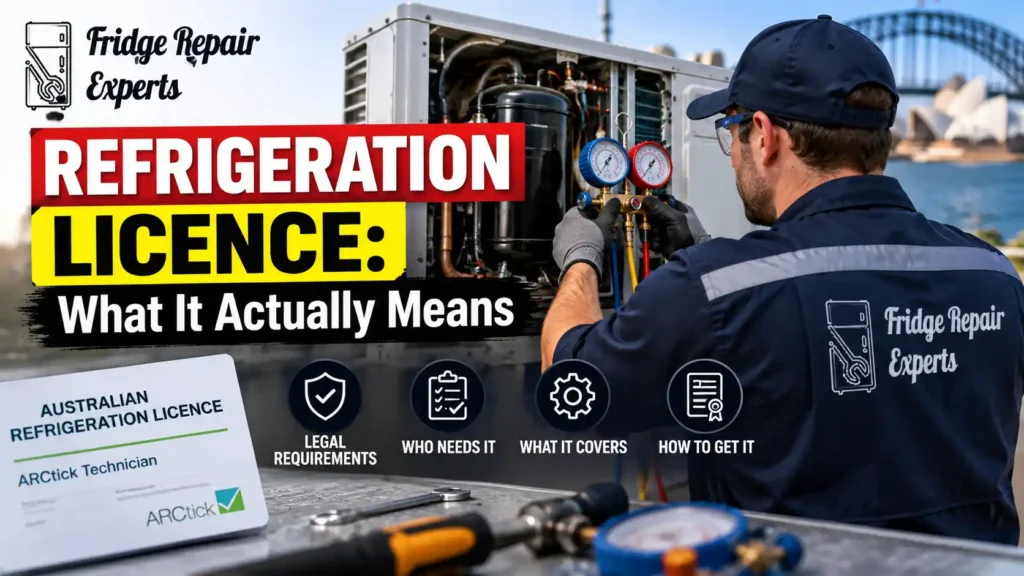
What a refrigeration licence means in practice is usually two separate things that both apply in NSW: the federal Refrigerant Handling Licence (commonly called an ARCtick licence, issued by the Australian Refrigeration Council) which covers anyone in Australia who handles refrigerant, and a separate NSW Fair Trading licence or certificate required specifically to carry out air conditioning and refrigeration work as a trade in this state. Most working technicians need both. This guide explains refrigeration licence requirements at both the federal and NSW level — what each one actually covers, who needs one, what counts as “handling” refrigerant under the law, and why it’s worth checking before you let anyone touch a refrigeration system.
Why There Are Two Licences, Not One
Refrigeration work sits at the intersection of two different regulatory concerns, and Australia handles them through two separate systems.
The first concern is environmental: fluorocarbon refrigerants (the gases inside fridges, freezers and air conditioners) are ozone-depleting, potent greenhouse gases, or both, and letting them escape into the atmosphere causes real environmental harm. That’s a national issue, so it’s regulated federally.
The second concern is trade competency and consumer protection: refrigeration and air conditioning work involves electrical components, pressurised systems, and installations that need to be done correctly for safety reasons, on top of the environmental issue. That’s regulated at the state level, alongside other trade licensing like electrical and plumbing work.
The result is that a technician working under a refrigeration licence NSW recognises generally needs to satisfy both systems — the federal one for handling refrigerant anywhere in the country, and the state one for doing the trade work itself in NSW specifically. This is the same structure that applies to refrigeration license Australia-wide, since every state pairs the same federal scheme with its own trade licensing.
The Federal Layer: ARCtick / Refrigerant Handling Licence
This federal ARC licence refrigeration technicians must hold is administered by the Australian Refrigeration Council (ARC), appointed by the federal government in 2005 to administer refrigerant handling under the Ozone Protection and Synthetic Greenhouse Gas Management Regulations 1995. The licence it issues is officially called a Refrigerant Handling Licence, though it’s very commonly referred to as an “ARCtick licence” after ARC’s registered trademark and licensing brand.
What counts as “handling” refrigerant is broader than most people expect. Under the regulations, it covers doing anything with a fluorocarbon refrigerant, or a component of refrigeration and air conditioning equipment, that carries a risk of the refrigerant being released — including manufacturing, installing, commissioning, servicing, or maintaining equipment, and decommissioning or disposing of it. Importantly, this applies whether or not refrigerant is actually present in the system at the time of the work. Simply working on the equipment itself, even with the refrigerant already removed, can still count as handling under the definition.
Read Also: Westinghouse Fridge Not Cooling? Here’s What’s Going On
Handling covered refrigerant without a licence is an offence of strict liability, meaning intent doesn’t need to be proven — doing the act itself is enough to breach the regulation. The refrigerants covered include CFCs, HCFCs, HFCs, PFCs, and halon used in refrigeration and air conditioning systems.
There are two levels within this federal system:
- Refrigerant Handling Licence (RHL) — the individual, technician-level licence that permits a person to actually do the work.
- Refrigerant Trading Authorisation — a separate, business-level permit that allows a company to acquire, possess, and dispose of refrigerant, distinct from the individual technician’s licence. Together these two make up what most people simply call a refrigerant licence Australia-wide.
ARC also runs a voluntary Green Scheme Accreditation for lower-GWP refrigerants not yet covered by the federal regulations, which some states (including NSW) accept as evidence of OH&S competence for handling those newer refrigerant types.
The State Layer: NSW Fair Trading Licence
Separately from the federal ARCtick system, a refrigerant handling licence NSW tradespeople also need comes through NSW Fair Trading, which regulates air conditioning and refrigeration work as a licensed trade under the Home Building Act 1989. You need a licence or certificate before carrying out this work in NSW, and that requirement extends to any electrical wiring associated with the job that would otherwise need an electrician.
NSW offers a few different licence and certificate types depending on the role:
- Qualified Supervisor Certificate — permits the holder to carry out the work as an employee, or to supervise others doing it.
- Endorsed Contractor Licence — a refrigeration contractor licence for a sole trader or business that wants to contract directly for air conditioning and refrigeration work, or supervise it.
These are issued for 1, 3, or 5 year terms, and applicants need to demonstrate the right qualifications and experience, along with a National Police Check no older than four months.
Doing this work in NSW without the appropriate licence or certificate is a breach of the Home Building Act. Unlicensed electrical work carried out as part of unlicensed air conditioning and refrigeration work carries penalties that can run into tens of thousands of dollars for an individual, and considerably more for a company. One exception worth knowing: duct work carried out outside of a dwelling doesn’t require this licence.
How the Two Systems Fit Together in Practice
For a technician actually working on refrigeration or air conditioning systems in NSW, both licences are generally required together, not as alternatives. The typical pathway looks like this: complete a nationally recognised qualification (commonly a Certificate III in Air Conditioning and Refrigeration), which makes you eligible to apply for both the NSW Fair Trading licence and the federal Refrigerant Handling Licence. From there, a technician working under supervision as a trainee, or independently once fully qualified, needs both credentials current and in place to legally do the work.
This is also why a genuinely licensed refrigeration mechanic Sydney or NSW households hire is a meaningful thing to check for, rather than a box-ticking formality. Someone missing either credential isn’t simply lacking a piece of paper — they’re either not legally permitted to handle the refrigerant in your system at all, not legally permitted to do the trade work in NSW, or both.
Who Actually Needs a Refrigeration Licence
Domestic and commercial refrigeration technicians — anyone servicing, repairing, installing or decommissioning fridges, freezers, cool rooms, or commercial refrigeration equipment where refrigerant handling of any kind is involved.
Air conditioning installers and technicians — the same core requirement applies, since air conditioning systems use the same class of regulated refrigerants and an air conditioning and refrigeration licence in NSW covers both trades together.
HVAC contractors more broadly, where their scope of work includes refrigerant-handling components.
What doesn’t require this licence: basic cleaning, moving an appliance, or working on components that don’t involve refrigerant or risk its release. This is part of why something like condenser coil cleaning is genuinely safe to do yourself — it doesn’t touch the sealed, regulated part of the system — while opening the sealed refrigerant circuit, for any reason, does require a licensed technician.
Why This Matters When You’re Hiring Someone
For a household or business booking commercial refrigeration licence-holding technicians, or arranging a simple refrigeration repair licence check on a domestic job, licensing isn’t just a compliance detail — it’s a genuine indicator of whether the person working on your system is legally permitted to be doing so, and whether they’ve met the training standard the licence represents. ARC conducts more than 5,000 audits of licence holders every year specifically to maintain that standard, which is a meaningful level of ongoing oversight compared to an unregulated trade.
If you’re ever unsure whether a refrigeration technician Sydney has sent to your property holds a current licence, you’re entitled to ask, and a legitimate technician should be able to confirm it without hesitation.
Read Also: Fridge Temperature Setting Australia: What It Should Actually Be
A refrigeration licence Sydney customers can actually verify matters more than a generic claim of being “licensed” — Fridge Repair Experts’ technicians hold current Refrigerant Handling Licences and the relevant NSW trade credentials for the work they carry out, alongside full insurance and a workmanship warranty on every repair. Call 0468 340 685 to book a licensed technician for your fridge or refrigeration repair.
Frequently Asked Questions
What is a refrigeration licence?
It generally refers to two separate credentials in NSW: the federal Refrigerant Handling Licence (ARCtick), which covers anyone in Australia handling regulated refrigerants, and a separate NSW Fair Trading licence or certificate required to carry out air conditioning and refrigeration work as a trade in this state. Most working technicians need both.
Who needs a refrigeration licence in Australia?
Anyone carrying out work on refrigeration or air conditioning equipment that involves refrigerant handling — including installing, servicing, maintaining, or decommissioning equipment — needs a federal Refrigerant Handling Licence, regardless of which state they’re in. This applies even if the refrigerant has already been removed from the system at the time of the work.
What’s the difference between ARCtick and a NSW Fair Trading licence?
ARCtick is the federal Refrigerant Handling Licence, administered by the Australian Refrigeration Council, and covers refrigerant handling anywhere in Australia. The NSW Fair Trading licence is a separate, state-level requirement under the Home Building Act specifically for carrying out air conditioning and refrigeration trade work in NSW. Both are generally required together for a technician working in this state.
Is it illegal to work on a fridge without a refrigeration licence?
If the work involves handling refrigerant — which includes servicing, repairing, or decommissioning most refrigeration equipment, regardless of whether refrigerant is present at the time — then yes, doing that work without a current Refrigerant Handling Licence is an offence under federal law. Simple tasks that don’t touch the sealed refrigerant system, like cleaning condenser coils, don’t require this licence.
What is a refrigeration mechanic licence NSW technicians need to hold?
A refrigeration mechanic licence NSW recognises is really the Qualified Supervisor Certificate or Endorsed Contractor Licence issued by NSW Fair Trading, held alongside the federal Refrigerant Handling Licence. Both are needed together to legally carry out refrigeration and air conditioning work as a trade in this state.
How do you become a licensed refrigeration technician in NSW?
The typical pathway is completing a nationally recognised qualification, commonly a Certificate III in Air Conditioning and Refrigeration, which makes you eligible to apply for both the NSW Fair Trading refrigeration licence and the federal Refrigerant Handling Licence with ARC. Trainees can work under supervision while completing the required training and gaining experience.
What happens if a business uses an unlicensed technician?
The business or homeowner isn’t usually the one penalised for a technician’s lack of licence, but there are real practical risks — no assurance the work meets safety or environmental standards, potential issues with insurance or warranty claims if something goes wrong, and no guarantee the refrigerant was handled correctly rather than vented illegally. Checking a technician’s licence before work begins avoids all of this.
Does cleaning my own fridge’s condenser coils require a licence?
No. Condenser coil cleaning is an external maintenance task that doesn’t involve opening the sealed refrigerant system, so it’s safe and legal for a homeowner to do themselves. The licensing requirement applies specifically to work involving refrigerant handling, not general external maintenance.
Book a Licensed Technician
Whether it’s a domestic fridge, a commercial cool room, or general refrigeration maintenance, Fridge Repair Experts‘ technicians hold current, verifiable refrigeration licensing for the work they carry out. Genuine spare parts, full insurance, and a workmanship warranty on every repair.
Call 0468 340 685 to book a diagnosis or repair.